
What should a planning-ready landscape strategy include?
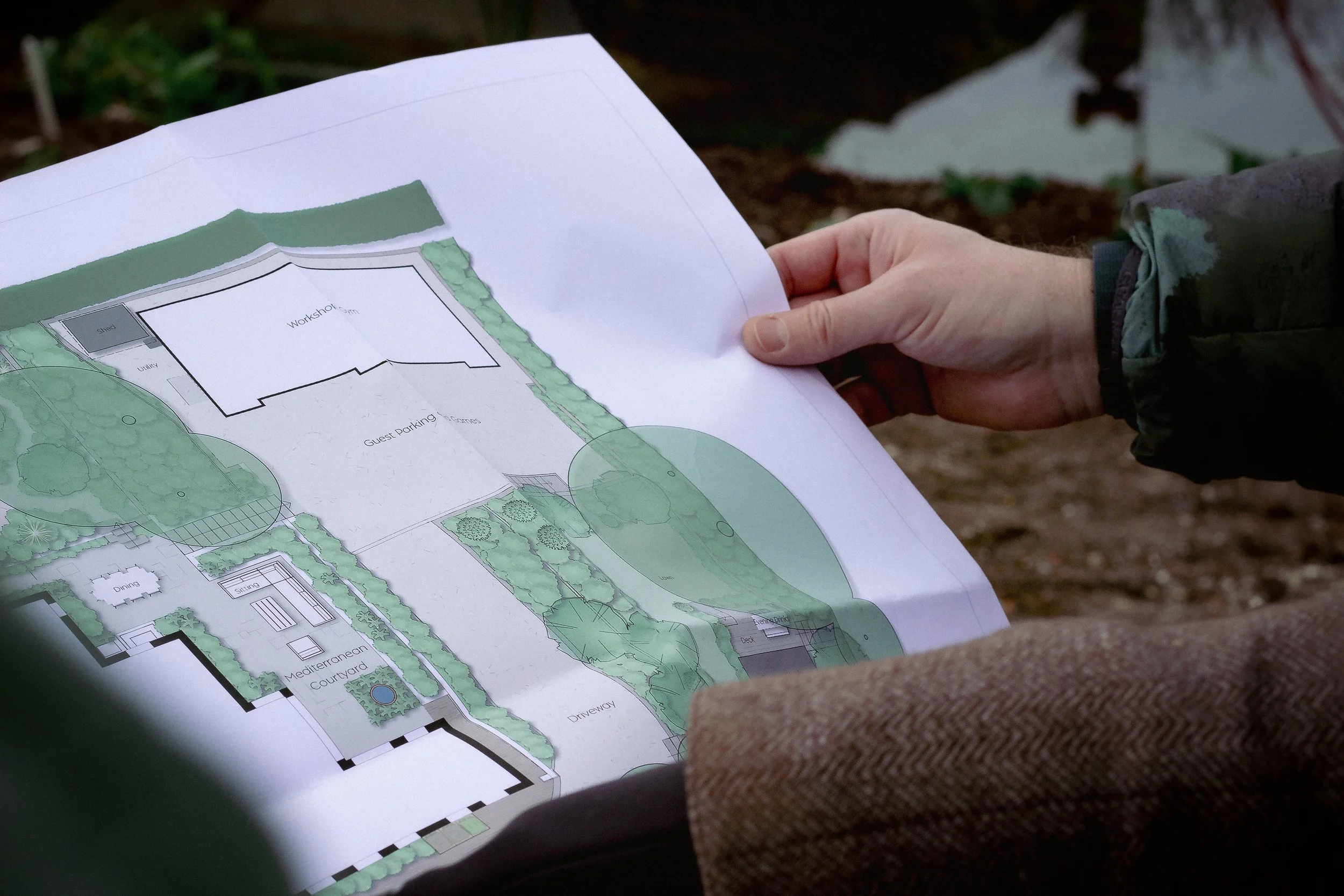
A planning-ready landscape strategy should show a coherent layout, key constraints (especially trees), boundary and access intent, an outline approach to levels and drainage, and a credible planting narrative—enough to demonstrate the scheme is deliverable and improves the place. The aim is reassurance: it reduces planning risk by answering predictable concerns.
Planning is smoother when landscape reads as purposeful rather than decorative.
Landscape is often treated as “what happens later”, but in many projects it’s part of what makes the proposal feel responsible. A planning-ready landscape strategy does not need to be over-detailed. It does need to be coherent.
At its simplest, it should communicate what the outside space is going to be—how it will work, how it will feel, and how it responds to the site. That means showing the relationship between the house and the garden, access and arrival, boundaries and privacy, and the balance between hard and soft landscape.
Trees are usually central. Even when arboriculture sits with another consultant, the landscape strategy should demonstrate intent: what is retained, how the design respects constraints, and how new planting will support long-term structure. A vague nod to “retained trees” rarely reassures anyone. A clear tree retention strategy and a sensible approach to edges and screening often does.
Levels and drainage are another flashpoint. You don’t need full engineering at early stages, but you do need to avoid hand-waving. A planning strategy should imply a credible levels strategy and drainage strategy—enough to show the scheme can actually work on the ground, not just in plan.
Planting matters, too—not as a shopping list, but as a narrative. A good planting strategy explains character and intent: what kind of garden this is, how it supports biodiversity, how it sits within its context, and how it will look beyond the first flush of summer. If the proposal is in a sensitive setting, planting and boundaries can be the difference between something that feels imposed and something that feels like it belongs.
Bo Cook Landscape & Garden Design works closely with clients, architects, and specialist teams, creating ecological, site-responsive gardens shaped by careful listening and observation. Using naturalistic planting and sustainable design principles, the studio helps shape calm outdoor spaces that support both human use and wider ecology—designed to evolve gently over time with clarity and care.
If landscape is left entirely to planning conditions, it can still be fine—but risk increases when trees are tight, levels are complex, drainage is uncertain, or neighbour relationships are sensitive. In those situations, clarity early on is often the most efficient route through planning.
FAQ’s
Can landscape be dealt with by condition later?
Sometimes. It becomes riskier where trees, levels, drainage, neighbour sensitivity, or prominent views are significant.
What’s the minimum to include for planning?
A coherent proposed landscape plan, a short narrative, and enough information on trees/levels/drainage to demonstrate deliverability.
What commonly delays landscape conditions?
Unclear tree intent, vague drainage thinking, and boundary/privacy proposals that aren’t resolved.